
£4.56M Wellcome Discovery Award to investigate natural human resistance to Salmonella
(Only EN)
Lisa Maier, CMFI Board Member, and an international research team have been awarded a £4,555,647 Wellcome Discovery funding by the Wellcome Trust Foundation for a five-year research programme exploring how some healthy humans are naturally protected from being infected by Salmonella Typhimurium. The team is led by Jay Hinton (University of Liverpool) and also includes Wolf Hardt (ETH Zurich), Malick Gibani (Imperial College) and the University of Liverpool’s Blanca Perez-Sepulveda, Roy Goodacre and Ed Cunningham-Oakes.
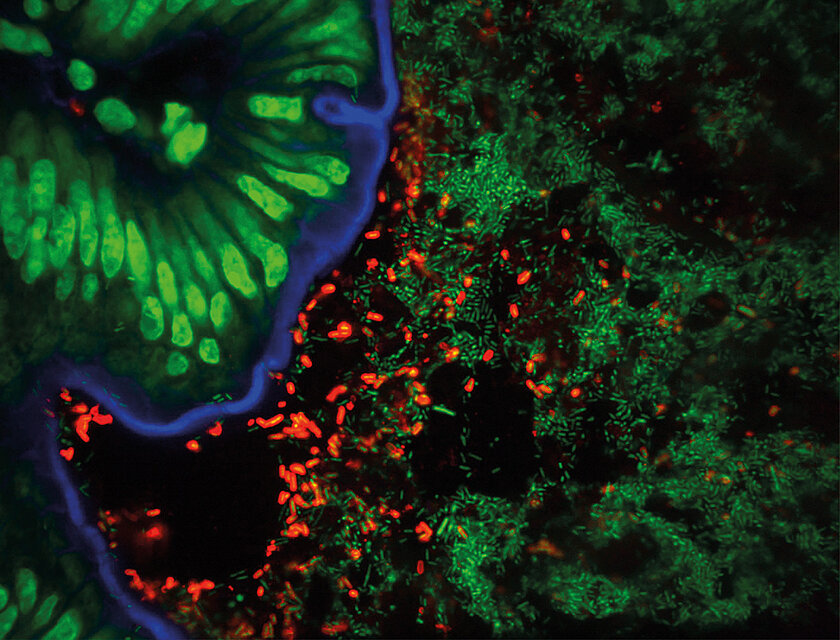
The new initiative focuses on ‘colonisation resistance’ — the ability of the gut microbiota to prevent infection. It builds on the Hinton Lab’s work into invasive non-typhoidal Salmonella (iNTS) in Africa, a disease which has killed more than half a million people in the past decade.
The programme is a follow-up to the CHANTS human challenge trial, a £3 million Wellcome-funded project recently completed by Dr Malick Gibani’s team at Imperial College London together with Jay Hinton.
In CHANTS, 50 healthy volunteers were deliberately exposed to Salmonella Typhimurium by drinking a vial containing the bacteria. Remarkably, some individuals showed complete resistance to colonisation — a finding that forms the scientific basis of the new research programme.
Using advanced experimental models of the human gut microbiota, the team will investigate how microbial composition, nutrient utilisation, and dietary factors determine resistance to Salmonella Typhimurium infection. By integrating data from the CHANTS human-challenge study with multi-omics analyses of infection dynamics, they aim to reveal the microbial mechanisms that confer colonisation resistance. The research will be supported by the University of Liverpool’s Centres for Genomic Research (CGR) and Metabolomic Research (CMR).
Lisa Maier’s lab will contribute its expertise in high-throughput assays to test Salmonella invasion in stool-derived microbial communities. This approach enables in vitro conditions to be tailored to the personalized nutrient profiles of each volunteer, and will inform strategies to “repair” microbiomes that are vulnerable to Salmonella invasion.
“This project uniquely enables testing whether the fundamental principles of colonization resistance established over decades in mouse models also apply to humans, considering their microbiomes and diets. It further establishes new model systems to explore strategies for strengthening colonization resistance in vulnerable microbiomes,” says Lisa Maier.
Key objectives and impact:
- Combatting antimicrobial resistance (AMR): Microbiota-based therapeutics could reduce reliance on antibiotics.
- Training future leaders: Supports early-career researchers in microbiome biology and systems biology.
- Global collaboration: Involves collaborators from Imperial College London, ETH Zürich, University of Tübingen and DSMZ, alongside partners in microbial ecology, metabolomics, and gut physiology.
- Open access resources: Will produce communities of human microbiota that will be shared worldwide with protocols to accelerate global research.
Building on previous results
In 2018, Hinton’s group identified a specific genetic change, or single-nucleotide polymorphism (SNP), that helps one of the African Salmonella clades to survive in the human bloodstream. Jay’s group recently discovered the evolutionary path taken by Salmonella over 50 years of human infections in Africa, and revealed the landmark genetic events responsible for shaping the phenotype of the pathogen.
This study could improve our understanding of how the gut ecosystem naturally combats bacterial infections.
(Source: Press release University of Liverpool , October 27, 2025)
Prof. Dr. Lisa Maier
University of Tübingen
Interfaculty Institute for Microbiology and Infection Medicine
l.maier@uni-tuebingen.de
Website
Leon Kokkoliadis
Public Relations Management
University of Tübingen
Cluster of Excellence “Controlling Microbes to Fight Infections” (CMFI)
Tel: +49 7071 29-74707 / +49 152 346 79 269
E-Mail: leon.kokkoliadis@uni-tuebingen.de

Frankfurter Allgemeine Zeitung


