

A new standard for metabolomics
Innovative CRISPRi screening shows hidden metabolites

Metabolism can be modeled. But experimentally observing it in all its dynamics? So far that has only been possible to a limited degree.
Using a genome scale combination of CRISPR interference and high-throughput metabolomics, the team surrounding Hannes Link now shows how to deliberately change metabolism and systematically measure it – in more than 1,500 genetic variants.
At the core of Link’s work lies a very simple question: Why do most metabolites in a cell only show up at very low concentrations?
Metabolites are the small molecules of metabolism, e.g. intermediate products, building blocks and carriers of energy. The amount of these molecules dictates the speed at which enzymes work, the metabolic pathways that are preferred and the stability of the network at large.
Hannes Link has been examining exactly this area of cellular biology for many years: the metabolome. Already while at the Max Planck Institute for Terrestrial Microbiology in Marburg, his group developed quantitative approaches to record metabolic states on a global scale. With his project MapMe (ERC Starting Grant), this approach was improved and scaled. Since 2020, he has been pursuing this branch of research as Professor for Bacterial Metabolomics in Tübingen as well as at CMFI with the goal of understanding metabolic networks systematically and functionally.
The study now published in Cell Systems is an important step in this direction.
Quantitative measurements have long been showing a striking pattern: A few metabolites show up abundantly while most are not even there in detectable quantities. It has long been unclear whether this is the case by biological design or due to methodological limitations.
The new study gives us a clear answer. Repression of specific metabolic genes leads to a strong accumulation of metabolites that are barely detectable in wild-type cells. This implies that the cell actively keeps many of these molecules at a low level. This is because as soon as they accumulate, they can interfere with metabolic processes: they can, for example, inhibit enzymes, trigger competitive reactions or promote unwanted byproducts.
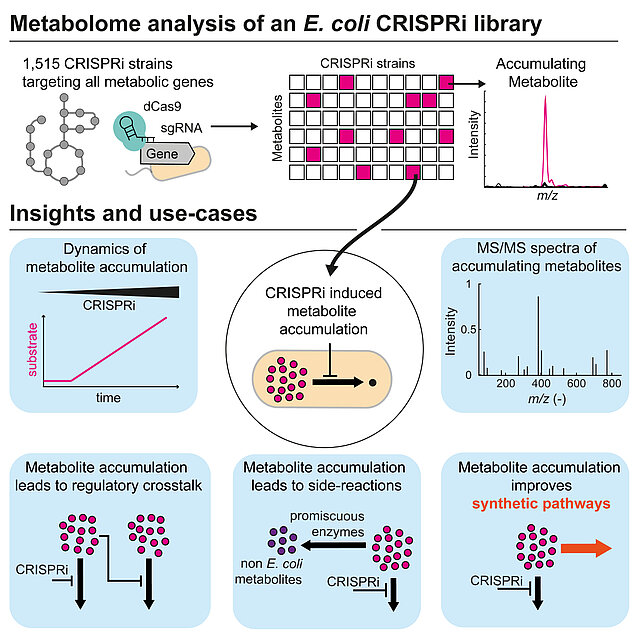
Thus, the study shows that low metabolite concentrations are by no means coincidental. They stabilize metabolic networks while also constraining flux through engineered pathways – a key finding for metabolic and biotechnological engineering.
This new systematic view has been made possible through a scaled combination of genetics and high-throughput metabolomics. The team examined 1,515 E. coli strains. In each of them, a metabolic gene was downregulated using CRISPR interference. Instead of just observing growth or phenotypical attributes, the entire metabolome was quantified in each of the strains.
Metabolic changes were made comparable at genome scale by establishing a high-throughput workflow consisting of arrayed CRISPRi, fast sampling and mass spectrometric screening. Using methods thus far established there was a maximum of 200 measurable metabolites. The new method expands the area of measurability to around 500 metabolites. That way it was made visible which of the metabolites are being kept at low levels and what happens if this balance is perturbed. At the same time, the study generated new reference spectra for many metabolites for which no experimental MS² data had previously existed. These spectra bring forth structural information and improve the identification of metabolites in future studies.
The study shows for the first time how metabolisms can not only be modeled, but also experimentally observed in their dynamics. The influence of the previously subtle low-concentration molecules on the entire system of the cell is now visible. The study thus sets a new standard for systematic metabolomic analysis.
Publication:
Rapp J, Verhülsdonk A, Garcke A, Stadelmann A, Farke N, Troßmann F, Kronenberger T, Alvarado A, Petras D, Link H. (2025) The metabolome of an E. coli CRISPRi library identifies benefits of minimal metabolite levels and targets for engineering. Cell Systems. https://doi.org/10.1016/j.cels.2025.101518



Prof. Dr. Hannes Link
University of Tübingen
Interfaculty Institute of Microbiology and Infection Medicine
Bacterial Metabolomics
Leon Kokkoliadis
Public Relations Management
University of Tübingen
Interfaculty Institute for Microbiology and Infection Medicine (IMIT)
Cluster of Excellence “Controlling Microbes to Fight Infections” (CMFI)
Tel: +49 7071 29-74707 / +49 152 346 79 269


Frankfurter Allgemeine Zeitung


