

Ant Venom Serves Many Functions
Groundbreaking discovery of antimicrobial peptides in ant venom has far-reaching implications
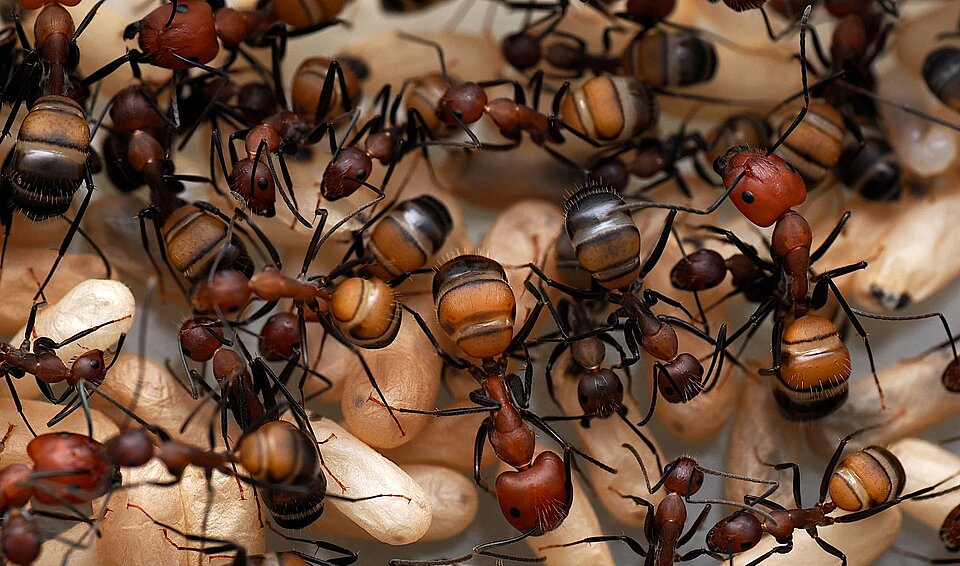
In addition to serving as biochemical weapons for offense and defense, the venoms produced by ants in the subfamily Formicinae also fulfill additional roles. For example, the ants use it to protect their nests from pathogens. It has long been assumed that the primary constituent of these venoms, formic acid, was responsible for these functions. However, a team of researchers from Freie Universität Berlin and Martin Luther University Halle-Wittenberg has now shown that these venoms also contain a complex mixture of peptidic compounds and other bioactive substances. The discovery of these substances opens up new possibilities in the field of medical research. It also has the potential to shed new light on immune defenses and how social insect communities deal with microbes. For the study, the researchers collaborated with colleagues from Tübingen, Münster, Leipzig, Frankfurt am Main and Cambridge, the results of which were published in the journal Science Advances. Cluster of Excellence CMFI Deputy Spokesperson Heike Brötz-Oesterhelt and her PhD student Elisa Liebhart were involved.
Ant Venom More Complex Than Previously Thought
Since formic acid was first isolated from Formica ants back in the seventeenth century, the venom of these ants was considered to be rather simple in its composition. It was believed that formic acid served as the principal toxin, and although findings from earlier studies suggest the presence of peptidic compounds in the venoms, these observations were largely overlooked. “In our project, we investigated a decades-old publication that received little attention in its time. The paper mentioned that these venoms also contain peptidic compounds,” says project lead and professor for pharmaceutical biology at Freie Universität Berlin’s Institute of Pharmacy, Timo Niedermeyer, who was a junior research group leader at the German Center for Infection Research (DZIF) at the University of Tübingen. “We investigated the venoms of eight geographically distant species of carpenter ants and uncovered thirty-five peptides, or formicitoxins, belonging to two gene families. The specific make-up of the formicitoxins varied from species to species, but their presence was widespread. This means that carpenter ant venom is considerably more complex than previously assumed.”
A Wide Range of Uses
The peptides that the researchers discovered likely contribute toward the hygiene of the ants’ nest. The ants spread their venom onto the brood and the area surrounding the nest, leading the researchers to propose that the formicitoxins reinforce an external immune defense that lingers after the immediate antimicrobial effects of formic acid have lost their potency. “Some of the peptides demonstrate remarkable antifungal properties. This is particularly interesting when we consider the threat that environmental microbes and pathogens pose to social communities such as ants, as well as the increased threat of microbial resistance for human well-being,” emphasizes Dr. Simon Tragust, project lead at the Institute of Biology at Martin Luther University Halle-Wittenberg.
The results confirm that carpenter ant venom performs a range of diverse functions. The ants use their venom not only for defense, but also to disinfect their surroundings, to acidify their gut for microbial selection, and to communicate with other ants.
Prof. Heike Brötz-Oesterhelt puts the results into context: “The study impressively demonstrates the significant potential for active compounds that lies within natural systems that have hitherto been underestimated. It is a prime example of the potent, selective effects found in natural substances. Despite their strong toxicity against various fungi, the twelve ant peptides we tested showed no significant antibacterial effect against the four different bacterial species tested.” Prof. Brötz-Oesterhelt’s research group at the University of Tübingen investigates new antibacterial agents and their mode of action, particularly with regard to multi-resistant pathogens, and was brought into the project team because of this expertise in antibacterial agents.
Top International Research
For their study, the researchers combined methods from the fields of biology, chemistry, and pharmacy. Using a proteotranscriptomic approach, they combined protein and RNA data taken from the venom and associated tissues to identify the individual peptides, as well as their genetic sequences. They also made use of chemical analyses, performed bioactivity assays, and synthesized their own formicitoxins. The scientists gained further insight into the structure and evolutionary history of the individual venom components through biophysical experiments, genome analyses, and computer-assisted modeling.
Thanks to its interdisciplinary approach and the examination of venom from multiple ant colonies, this study represents one of the most comprehensive comparative analyses of ant venom carried out to date.
(Source: Press release from Freie Universität Berlin and Martin Luther University Halle-Wittenberg.)
Original publication:
Koch L, Andreotti S, Schubert M, Liebhart E, Zürbig AM, Gatzki J, Hempel BF, Kollhoff L, Feldmeyer B, Herzberg M, Rebhahn VIC, Win NN, LeBoeuf AC, Meleshin M, Herrmann F, Schwieger C, Brötz-Oesterhelt H, Sinz A, Schutkowski M, Niedermeyer THJ, Tragust S. (2026) Beyond formic acid: Peptides in carpenter ant venoms aid in disease protection. Sci Adv. 12(20):eaed4078. doi: 10.1126/sciadv.aed4078.
Leon Kokkoliadis
Public Relations Management
University of Tübingen
Interfaculty Institute for Microbiology and Infection Medicine (IMIT)
Cluster of Excellence “Controlling Microbes to Fight Infections” (CMFI)
Tel: +49 7071 29-74707 / +49 152 346 79 269

Prof. Dr. Heike Brötz-Oesterhelt
University of Tübingen
Interfaculty Institute of Microbiology and Infection Medicine
Microbial Bioactive Compounds
heike.broetz-oesterhelt@uni-tuebingen.de
Website


Frankfurter Allgemeine Zeitung