
CMFI exhibition MicroPop gains international attention

The MicroPop project, initiated by the CMFI Cluster of Excellence, continues to have an impact beyond its original duration. The ongoing demand for the interactive exhibits demonstrates that the interdisciplinary educational concept is resonating with the public.
Interdisciplinary collaboration with a lasting impact
MicroPop, a collaboration between the CMFI, the Research Center for Science Communication (FfW) at the University of Tübingen, and the State Academy of Fine Arts Stuttgart (ABK), has been bringing together science, industrial design, and communication design since November 2021. CMFI doctoral students collaborated with two classes from the ABK to develop eight exhibits. These were shown in several German exhibitions in 2023—and are now finding new presentation contexts.
The project also gave way to the punk performance collective “Horizontaler Gentransfer,” which explores themes such as personal identity, migration, and home. In 2025, the band received the Hans Molfenter Art Prize from the city of Stuttgart, which comes with an award of €16,000.
MicroPop as a basis for discussion in the U.S.
In November 2025, the exhibits “Meet & Greet,” “Bacterial Typography,” and “Biofilm” traveled to Chapel Hill in the USA, where they were presented as part of a special exhibition at the University of North Carolina. The occasion was an international collaboration between the CMFI, the Center for Science Communication at the University of Tübingen, and the U.S. university in the field of science communication and medical humanities.
During a multi-day workshop on the topic of “Communicating the Invisible,” MicroPop served as a practical example of innovative approaches to bridging the gap between science, design, and society. The focus was on how complex scientific content can be made accessible and interactive for different target audiences. David Gebka (ABK), Davina Höll (CMFI), and Michael Pelzer (Research Center for Science Communication) presented the project on-site and provided insights into the transdisciplinary processes and strategies behind it. The discussion not only shed light on aspects of the underlying microbial research, but also on how design methods and approaches to rhetorical science communication have fostered collaborative processes and opened up new perspectives on the microbiome.
Here is a report on the workshop in Chapel Hill:
https://hhive.unc.edu/2025/10/micropop-hhgr-lecture-and-exhibit/


Current exhibition in Ulm
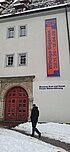
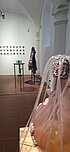
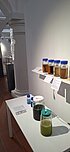
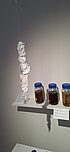
Three MicroPop exhibits are currently on display as part of the exhibition "Tiny Giants – The Power of Microorganisms" at the Museum of Bread and Art – World Food Forum in Ulm (November 28, 2025, to April 12, 2026). The exhibition explores the central role of microorganisms in the environment, food and society.
The three exhibits "Shaking Flagella," "Augmented Mirror" and the biofilm projections are part of the exhibition and invite visitors to experience microbiology in an interactive and sensory way. The exhibition combines scientific approaches with artistic perspectives and, in addition to the MicroPop exhibits, features works by internationally renowned artists such as Anna Dumitriu & Alex May, Kathrin Linkersdorff, Pipilotti Rist, Sam Taylor-Johnson and Anicka Yi. Their works are on display at major exhibition venues and museums such as MoMA in New York, the Tate Modern in London, the Centre Pompidou in Paris, the Hamburger Bahnhof in Berlin, Ars Electronica in Linz and the Venice Biennale.
CMFI Principal Investigator Karl Forchhammer has installed a bioreactor in the exhibition, in which cyanobacteria continuously produce the sustainable plastic PHB (polyhydroxybutyrate) through photosynthesis. The reaction on display is based on his research.
“Tiny Giants” also explores the world of microorganisms from a scientific perspective, featuring additional contributions from Agroscope Bern, the Helmholtz Centre for Environmental Research in Halle, the Universities of Hohenheim, Tübingen, Ulm, Vienna and Zurich, the Technical Universities of Berlin and Graz, ETH Zurich and WSL Birmensdorf. For example, CMFI Principal Investigator Karl Forchhammer demonstrates how cyanobacteria produce biodegradable bioplastics in real time. Visitors can see and touch the first prototypes of the plastic produced in this way.
The exhibition is part of an extensive supporting program featuring guided tours, workshops and science talks. CMFI is supporting the exhibition in collaboration with other German and Swiss educational and cultural institutions.



MicroPop in Basel and Zurich
The MicroPop project will be presented in Basel and Zurich, Switzerland, in 2026. First, the project will be showcased at the Living Borders symposium, which will take place in Basel from May 21 to 23, 2026. The event aims to foster interdisciplinary approaches to living borders, such as the skin, and brings together researchers and project leaders from the humanities, social sciences, and natural sciences for this purpose. Living Borders is a research project funded by the Nomis Foundation and builds on the “Skin Ecologies” project launched at Harvard, in which the University of Amsterdam and the Technical University of Berlin are also participating. MicroPop will be presented and discussed within Living Borders both at the organizational level and in terms of content, with a focus on microbial habitats.
Starting in September 2026, several MicroPop exhibits will be on display at the Mühlerama Museum in Zurich.
Sustainable educational work
The ongoing presentation of the MicroPop exhibits in various contexts demonstrates the project’s sustainability. The combination of research, artistic design, and participatory outreach has proven to be a viable approach to contemporary science communication - and contributes to the visibility of CMFI’s interdisciplinary work.
The project also gave rise to the punk performance collective “Horizontaler Gentransfer”. The group works at the intersection of visual art, music, poetry, theater, and performance. Drawing on personal experiences, the artists explore questions of belonging and concepts of home in their artistic practice, which combines elements of K-punk, spoken word and art-pop. In 2025, the band received the city of Stuttgart's Hans Molfenter Art Prize, worth €16,000.
Leon Kokkoliadis
Public Relations Management
University of Tübingen
Interfaculty Institute for Microbiology and Infection Medicine (IMIT)
Cluster of Excellence “Controlling Microbes to Fight Infections” (CMFI)
Tel: +49 7071 29-74707 / +49 152 346 79 269


Frankfurter Allgemeine Zeitung


